Monday, October 26, 2009

We Both Go Down Together: The Savior Complex in YA Lit


Disclaimer: I have absolutely no background in psychology or analysis. This week, I am calling it as I see it from personal experience and from a teeny bit of reading on the subject.  Here goes:

We've all met someone with a savior complex.  You may also know it as a "Jesus complex" or a "hero complex."

In case you don't call it that, here's the standard SC profile (from my untrained, pedestrian perspective): at first glance, they come off as the nicest people alive.  Congenial, well-liked, polite to a fault.  The go-to guy/gal to escort you home from a party, give your sputtered-out car a jump, lend you a book/sweatshirt/iPod.  For a while, you may be fooled into thinking they are your best friend, that you can count on them for anything.

Well, if you are an independent, secure person, you cannot.

It's not that SC's are sociopathic serial killers.  Quite the opposite: they are generous of heart and eager to please.  Almost too eager.  They may or may not have their own personal demons which they have yet to overcome.  They are ALWAYS attracted to those on the fringes: individuals who wear their dysfunction on their tattered sleeves and require recovery by way of a professional.  People who many times realize that they themselves are trouble.  SC's, however, don't understand that.  They think that with enough love, understanding and tolerance, they can make anyone better.

And it always, always, always comes back to bite them you-know-where.

One of the the things I love most about contemporary YA lit is that it doesn't back away from the gray matter.  As in, protagonists you want to cheer for and scream at, sometimes within the same page.  Real teens with real faults that are relatable to adult readers as well.  In the past few months, I've read two fantastic YA novels by seasoned authors who don't get nearly the love they should, both involving compelling, complicated teenagers with one thing in common: the savior complex.  I give you: After the Moment, by Garret Freymann-Weyr, and Rage: a Love Story by Julie-Anne Peters.  (Don't worry, no spoilers ahead.)

If you've never experienced Garret Freymann-Weyr, get thee to Amazon or your local library post-haste.  Her protagonists may be youthful, but they are inherently old souls on the verge of a life-changing moment.  Don't mistake her extremely articulate writing and sophisticated urban settings for pretension: you'll miss out.  Freymann-Weyr's environments are the anti-Gossip Girl: the characters are semi-privileged, yes, but with an awareness of the considerable effort to maintain the lifestyle that is not without its share of guilt, and the constant reminders that no amount of money guarantees an immunity to disaster.

Seven years ago, one of my closest friends came out to me.  In an effort to understand what he was going through as best as a straight woman could, I did the first thing that came to mind: I hit the books.  At that point I discovered a host of phenomenal YA books with LGBTQ storylines.  Lesbian author Julie-Anne Peters is an absolute treasure in this regard: she takes us on the journeys of gay or questioning young people without ever once dipping into Lifetime Original Movie territory.  Her 2003 novel Keeping You a Secret is probably the best coming-out coming-of-age story written in the past twenty years.

In their most recent works, while tackling the savior complex, both Freymann-Weyr and Peters are also taking risks in their own writing.  In the case of After the Moment, Freymann-Weyr writes entirely from a male perspective for the first time.  And with Rage: a Love Story, Peters tackles an abusive relationship: where both the parties are girls.  Let's take a deeper look, shall we?

The SC's:
Leigh (After the Moment): your standard good guy.  Leigh is so good that he takes up running on the advice of his soccer coach, even though he hates it.  He's so good that his type-A girlfriend Astra handpicked him to be the recipient of her virginity. He's so good that when his little stepsister Millie asks him to relocate from New York to suburban DC for his senior year, to provide emotional support after the death of Millie's father, he says yes without a second thought.  That's when he meets Millie's girl-crush Maia Morland.  And the trouble begins.

Johanna (Rage: a Love Story): Like Leigh, Johanna has a family in a constant state of flux.  Her father passed away when she was twelve, her mother a couple of years later.  Johanna's older sister Tessa, who was in college at the time of the deaths, has only recently moved home with her husband.  Until that happened, Johanna was living on her own while serving as sole caretaker for her dying mother.  Now she frequents the hospice where her mom spent her last days.  Oh yeah, and Johanna's gay.  Her sister basically ignored Johanna's coming-out letter, and her mom didn't survive to hear the big announcement.  When the book begins, Johanna is asked to tutor the school Neanderthal--who happens to be the brother of Johanna's crush, Reeve.  And the trouble begins.

The survivors:
Maia (After the Moment): I really liked Maia--she's neither flighty manic pixie dream girl nor whiny victim. She's very upfront and matter-of-fact about her many issues: a beloved stepfather doing time for insider trading, bouts with anorexia and self-injury, and what looks to be OCD.  The self-professed "train wreck" eats dinner with Leigh and Millie's family every night and brings Millie high-quality bedding (for physical comfort) and romance novels (for emotional) after the sudden death of Millie's father.  She sports baggy clothes and always wears socks.  And bam, Leigh is sucked in.

Reeve (Rage: a Love Story): Reeve is the product of a dysfunctional, often-abusive upbringing, and it shows. She's beautiful, highly sexual and is often seen with an entourage of LBD's (Les Beaux Dykes).  Many times, Reeve is the only one who can get through to her brother, who's been described as a highly-functioning autistic.  Reeve also hits--girlfriends, stepdads, and anyone who tries to help her.  From page 1, the readers knows that Johanna is screwed.

The relationships:
Leigh/Maia (After the Moment): It starts with Leigh walking Maia home.  (Because he is a good guy, as you recall.)  Then he starts doing nice things for her--distracting her while she eats, so she doesn't get nervous; driving her to the prison to visit her stepfather.  Eventually, however, something awful happens. Something jaw-droppingly awful that leads to criminal negligence charges and a ton of blood (this is foreshadowed on page 2, so I'm not spoiling anything).  Something so awful and disturbing that when the book begins four years after the incident and Leigh encounters Maia at a dinner party, he's at a loss as to what to do.

Johanna/Reeve (Rage: a Love Story): From the beginning, Johanna is head over heels in lovelust for Reeve, whom she's spotted around school wearing skimpy outfits and a rainbow of eye makeup reflecting her current mood.  And once Johanna discovers how damaged Reeve is, it only gets deeper.  Trust me, you will be screaming at Johanna to stay away--it's like the scantily-clad heroine in a horror movie who decides she's going to go down to the basement.  Reeve is that basement.  Not inherently evil by any means, but definitely not a place where an innocent young woman should wander alone.

What makes both of these novels so strong is that there's no inherent "bad guy" (other than, of course, the awful people who inflict abuse and havoc on Maia and Reeve).  Yet, you're never completely in love with the protagonists' actions--in fact, they're downright exasperating at times.  With Johanna, you already know about my "don't go in the basement!" reaction.  With Leigh, I would roll my eyes, like, "dude, do you really think that talking to her so she can eat cake in public is going to compensate for the years of therapy that she herself admits she needs?"

Because that's the thing about the savior complex: at the heart of it is a selfishness that the individual him/herself often doesn't realize until they are called on it.  Again, they are not bad people and they genuinely want to help; however, there's also a factor of "I can and will rescue this person single-handedly because I am awesome" at work in every situation.  And God help those in the SC's life who may worry about their tendencies or who really need love and guidance.  (I won't say anything more than this: you'll feel terrible for Astra in After the Moment and Tessa in Rage: a Love Story).  Because once the SC has deemed someone a victim, they WILL help them--at all costs.  Even when the victim themselves admit that they are beyond help.

Don't get me wrong: I think kindness is a wonderful thing, and a quality I constantly try to improve in myself. It's essential for individuals to reach out to one another--everyone's got their shit, no man is an island, etc.  That said, there are those who require assistance from someone who has been trained to do so.  The savior complex is alive and well in society, and brava to Freymann-Weyr and Peters for spotlighting it so skillfully in their novels.

Oh, and one other thing: Ms. Freymann-Weyr?  If you are reading this, can you please give Millie her own book?  So many little sister characters are one-dimensional brats, but she is intelligent and delightful in a way that only a 13-year-old girl can be.  *bows down to your Buddha-like nature*

Monday, October 19, 2009

This One's For the Girls

OK, y'all, I've finally decided what I want to be when I grow up.  Are you ready?

*drumroll please*

When I grow up I want to be . . .

(deep breath)


Kathy Griffin.

Because I'm pretty sure when Kathy Griffin grows up she will be . . .


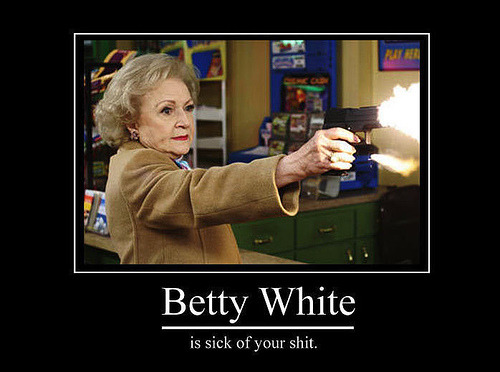
Betty White.

Here's why:

Like 95% of the stuff I eventually laud on this blog, Kathy Griffin had to win me over.  She's at times bewildered me and left me indifferent.  I was always glad that she was a female comedian who talked about more than dating and her menstrual cycle--and she was shrill, but in a way that didn't seem put upon--but at times I didn't...get her.  Kind of like Chelsea Handler.  I'd heard the sales pitch, I just wasn't quite ready to shell out for the product.

Then one night, my buddy Bob and I may or may not have gotten inebriated (hi, Mom!) and may or may not have returned to his apartment after stumbling to Jewel in our pajamas because we NEEDED margarita mix and brownies to celebrate the fact that our Last Five Years singalong had not caused his neighbors to file a noise complaint.  (We also may or may not have needed the entire next day to kick our hangovers.)  Bob popped in a DVD of Kathy's stand-up special, and I nearly peed my pink plaid pajama bottoms at her bit about what a bitch Gwyneth Paltrow is.  I'd always found Shakespeare in Love overrated (Saving Private Ryan was robbed), so I pointed at the TV and slurred, "Right on, sista!"

On and off, I've caught My Life on the D-List.  I never understood the whole Woz thing, but I did love how Kathy made a point to tour Iraq in between doing kooky things like introducing her niece to Laguna Beach heartthrob Talan.  And her parents, particularly her box wine-swilling mom, were just too cute.

Did I mention that I'm friends with a TON of gay men?  The gays love Kathy and Kathy loves the gays, so we have that in common too.  What I'm trying to say in my usual rambling manner, is that Kathy Griffin has wormed her proudly single, Irish Catholic, celeb-stalking way into my proudly single, Irish Catholic, celeb-obsessing heart.  (I still hold no hope for Chelsea Handler, though.)

I just finished reading Official Book Club Selection, Kathy's autobiography.  IMMEDIATELY, you guys.  Read it IMMEDIATELY.  Granted, I'm not sure how well all the pop culture references are going to hold up in even one year (of course, I could say the same thing about this blog!)  That said: what a cool, cool woman.  She puts all her shit out there and does it in style.  She's frank about her eating issues and plastic surgery, what she regrets and what she doesn't, and how body image is still something she wrestles with every single day.  (And you know what?  Unlike most famous ladies, I actually believe her.)  She goes into family secrets, mainly a disturbed older brother.  She expands on what went wrong in her now-defunct marriage.

But here's what I really took away from the book: damn, Kathy Griffin is tenacious.  At a time when reality TV makes people famous for being famous, you've gotta love someone who has worked her ass off since she was eighteen, not stopping for breath even after her friends (Janeane Garofalo, Lisa Kudrow, Andy Dick, and Margaret Cho) were getting TV and movie deals left and right while Kathy was struggling with glorified extra parts and sets at tiny comedy clubs.  You've gotta love someone who weaseled backstage passes to every single set she ever worked on--for her mom and dad, who charmed the bejeezus out of the likes of George Clooney.  You've gotta love someone who is at once snarky of celebrity culture and ravenous to be a part of it.

Here's a woman who saw what she wanted when she was a teenager.  Didn't stop till she got it, and still hustles her butt off.  Say what you want about her schtick, the truth is this: Kathy Griffin RAWKS.

And she needs to call me so we can get all our gays together for fruity cocktails and showtunes.

Oh, and Betty White?  To crib a 1920's bon mot, she's the bee's knees.  I know I don't need to convince you of that.  With all due respect to the late Bea Arthur, no other Golden Girl could deliver a honey-tinged insult quite like White's Rose Nyland.  And she's still kickin'--witness her hilariously profane turn as Ryan Reynolds' hot-to-trot grandma in the pleasant surprise of a romantic comedy The Proposal.  It's not just her lines, either.  When meeting Sandra Bullock's character for the first time, White rolls her eyes in a way that had me choking on my popcorn in delight.

Who's up for a Golden Girls marathon?  Memememe!

Monday, October 12, 2009

Remember the Time: Now and Then


This week, I conclude my Teen Girl Trifecta with a coming of age story rooted in nostalgia but quietly resonant nonetheless.

I can remember seeing Now and Then in the theatres with so much clarity it's a little scary.  I was probably wearing my favorite plaid shirt, to camouflage the boobs that I despised (like Christina Ricci's Roberta).  My mom drove us because we were a year away from our own licenses.  It was a Friday night and we had to wait in line, because our town was tiny and what else was there to do?  And most of all, I remember who I was with: my best friend Addie.  We were so excited for a girl-centric friendship movie, because we considered ourselves the only feminists in our Catholic high school.  And naturally, we adored Now and Then: for the rest of the year when things got rough, we'd remind each other, "It's normal for things to be shitty."

For a film that, as I recall, received very little marketing, there were a lot of interesting women involved.  Real '90's power players, young and old.  Not only does the pre-fembot Demi Moore show up onscreen as adult Samantha (her sultry voice carrying a lovely weight in the film's narration), she also executive produced the film with her oft-partner Suzanne Todd.  The director, Leslie Linka Glatter, has helmed several episodes of excellent television series such as Six Feet Under and most recently Mad Men.  And the 99% female cast is fantastic: Moore, Melanie Griffith (before she got all pufferfish scary), Rosie O'Donnell (before she got all militant), and Rita Wilson as the adult versions of their equally strong younger counterparts: Gaby Hoffmann, Thora Birch (recovered from the Macaulay Culkin mushmouth she had as a tot in All I Want for Christmas), Christina Ricci, and an unknown Canadian named Ashleigh Aston Moore (who died of respiratory failure in late 2007).  Plus, Janeane Garofalo, Bonnie Hunt and Cloris Leachman pop up in fun cameo roles (not to mention Demi Moore's own daughter, Rumer Willis).

Like I said, the film wasn't marketed much.  I remember previews and ads MAYBE a week before the release date.  It was one of those movies which the studio clearly had no idea what to do with.  (This is starting to become true for Whip It as well.)  Probably all the estrogen.  Scaaaaaaaary!  A film with that many cool girls and women couldn't POSSIBLY have anything to say to the public.  Right?

Wrong.

Among the many inequities in pop culture is this glaring annoyance: a film such as Stand By Me is lauded and praised for its sepia-toned illusion-shattering but lesson-learning portrayal of the child-teen brink.  Now and Then, on the other hand, while plenty loved by many women I know, gets written off as a "chick flick."  Don't get me wrong, I love Stand By Me.  However, Now and Then not only has many similar elements--sexual confusion, broken families, and a supernatural element, related largely in flashback form--but is just as well-acted and affecting without being manipulative.  Only it's about chicks, so it's not seen as universal.  Bull. Shit.

The plot is simple and straightforward: four far-flung childhood pals reunite in their old Indiana suburb and recall an eventful summer of their youth.  Samantha (Moore/Hoffmann), now a hardboiled sci-fi writer, remembers her parents' divorce, a neighborhood first.  Roberta (O'Donnell/Ricci), a sardonic doctor, was then a tough tomboy who taped down her tits while secretly mourning her mother's death.  Teeny (Griffith/Birch), now a sexpot actress, stuffed her chest with pudding-filled balloons and watched drive-in movies from her rooftop.  And Chrissy (Wilson/Aston Moore), an expectant mom, was intolerant of naughty words and obsessed with gardening, thanks to a metaphor-heavy sex talk from her well-meaning but misguided mother.  In the summer of 1970, they are twelve years old and have two goals: raise money for a fantastic treehouse (essentially a room of their own), and solve the mystery of a long-ago local death involving a boy their age known only as Dear Johnny.  All set to a background of pastels and love beads, and a groovy 70's soundtrack featuring not one but two Jackson 5 songs (yay!).

Most people use the term "tearjerker" to describe an emotional film.  I prefer "noseprickler."  As in, my nose gets all prickly the way it does before I get all choked up.  Now and Then has plenty of noseprickling moments.  After all, Roberta and Samantha are dealing with absent parents, carefully choosing what they do and don't reveal to their friends.  All four girls encounter lost souls such as a Purple Heart winner-turned-drifter (Brendan Fraser) and a lonely old man who's not as creepy as he seems, both of which alter their worldviews in ways that aren't always welcome.  Samantha in particular learns that "things happen beyond our control, but that's no reason to shut out the world"--revealing as an adult that it's taken her decades to fully process that advice.  And at the conclusion of the summer, the girls have met both their summer goals, but with very different results than they planned: mainly, the inevitability of their growing apart.

Don't get me wrong, there is as much hilarity.  Not only do the four younger actresses present believable relationship dynamics, but they really bring the funny.  The girls may squabble, tease and form alliances within their quartet, but they band together with a vengeance against the common enemy: boys, especially the Wormer brothers (adult Samantha dryly notes, "everyone in the neighborhood felt sorry for their mother").  Also, a sexist softball-game spectator who orders Roberta to "go home and play with your dolls" earns a well-deserved physical and verbal beatdown.

Less than a year after we watched Now and Then, like the girls in the film, Addie and I gained independence from each other.  We definitely stayed close and had more sleepovers.  However, we started seriously pursuing our passions: music for her and theatre for me.  She started dating the next semester; that summer, I fell in love.  Thanks to Facebook, we've very recently reconnected.  She's moved back to our old stomping grounds and has a husband and child, I'm a single gal in the city.  But like lovers always have Paris, Addie and I always have Now and Then.

Sadly, I have to wonder if a film like Now and Then could even be made today.  The story, while important and universal, isn't the sort of box-office and/or Oscar bait that studios crave these days.  On the other side of the coin, it's not quirky enough to be an indie.  Plus, the fact that there are boys' naked butts automatically disqualifies it from Disney.  However, I'm really not sure that today's young actresses could carry almost an entire film as subtly and skillfully as Ricci, Hoffmann, Birch and Aston Moore.  So maybe, even though it never got the mainstream attention it deserved, Now and Then was in fact, in the right place at the right time.

Friday, October 9, 2009

Touch-a-touch-a-touch-a-touch-me! (figuratively, of course)


So I've kicked things up a notch (and dated myself with an Emeril Lagasse reference) here at the Unpro.  Behold, new (for the blog) ways to interact and communicate!

1.  Become a fan of The Unprofessional Critic on Facebook and/or follow me on Twitter.  Why?  Because I post daily updates about what I'm watching and reading, along with the requisite snark or unbridled enthusiasm, depending on the subject matter.  These updates are unique to Facebook and Twitter, so it's like extra fun all week long!  I also provide links to new blog posts, so you don't miss out.

2.  Email me at maybeimamazed02[at]yahoo[dot]com.  Why?  Cause I lurves 'em.  Seriously, it's been really cool to hear from readers as far-flung as Amsterdam about how they found the blog, what they like about it, and suggestions for future posts.  I love suggestions and constructive criticism, and I really do listen--after all, YOU guys are the ones who tune in as I blather on about whatever's catching my pop culture fancy this week. 

Also, send a note if you've created something you'd like me to review.  Nothing makes me happier than advance screenings, galleys, DVD's, et cetera et cetera and so on.  I do have a few of these in the works, but in the meantime, lay it on me!  (That's what she said.  OR HE SAID.)

3.  Leave a comment!  After hearing from people that they couldn't comment, I checked out my settings, and true to my newbie-blogger self, discovered that they were more restricted than I would like.  Now, like Wal Mart at midnight on Black Friday, IT'S OPEN!  If you don't have an ID, just click "Anonymous" and you should be all set.

Lastly, ain't nothin' like word of mouth to spread the love.  PLEASE TELL YOUR FRIENDS ABOUT THIS BLOG!  I'm no Mean Girl.  The more, the merrier.

Happy Friday and stay tuned for Monday's post, where I complete my Teen Girl Movie Trifecta!

Friday, October 2, 2009

Maybe I'm Ready to Kick a Little Ass: Whip It


Everybody has a split second.

It's almost imperceptible, and often doesn't come to light until many years and life experiences later.  But if you look back really, really hard, you can find the split second where you experienced a clear, perfect vision of the person you wanted to become.

When I was a sophomore acting enthusiast at a teeny-tiny sports-crazy Catholic high school, I road-tripped with some friends to the small city near us (which seemed plenty big compared to our farm town) to see a play.  And not just any play, but a theatrical version of S.E. Hinton's The Outsiders, the first show in the area whose cast and crew was comprised entirely of teenagers.  That night I was feeling brave with my fashion choices and opted to go a little more funky, wearing a headscarf that my mom thought was weird and consequently I adored.  Before the show started, I headed up the aisle so I could go to the bathroom. 

That was my split second.

Because while headed up the aisle, I faced a crowded theatre full of people my age in weird clothes and rainbow-colored hair, all of us in the same place because we loved theatre and loved it even more when it was produced and performed by our peers. 

And from then on, my life cracked open.

That summer, I did my very first outdoor theatre production in that very same small city--with some of the very same people involved in The Outsiders. I discovered bands like They Might Be Giants, indulged my loud mouth, and realized that I wanted more than anything to study theatre.  In a weird twist of fate, I ended up dating The Outsiders' director's brother--who had seen me and my headscarf en route to the bathroom from his vantage point in the lighting booth.  Without even knowing it, he was part of my split second.

Which brings me to Whip It, Drew Barrymore's empowering and incredibly gratifying directorial debut, adapted from Shauna Cross' YA novel.  Don't get me wrong, I enjoyed the opening shenanigans, where small-town Texas teen Bliss Cavendar (the glowing Ellen Page) reluctantly participates in a beauty pageant while sporting the "temporary" blue hair color applied by her BFF Pash (Arrested Development's Alia Shawkat, in a long-overdue return to my life).  But the real beauty of the film, for me at least, began when 17-year-old Bliss experienced her split second.  On a trip to Austin with her pageant-princess-turned-postal-worker mom (a pitch-perfect Marcia Gay Harden), Bliss spots three tough, tattooed broads on skates cockily distributing flyers for a roller-derby exhibition.  Bliss' eyes widen, her breath catches, and her face longs for something that until that moment she didn't realize she wanted.  And in the audience, tears of recognition ran down my face because I'd never seen the split second captured that beautifully and accurately.

I'm ecstatic to report that the film just got better from there.

The story's both heartwrenchingly relatable--outcast teen discovers a whole new world outside her sheltered, suffocating environment and learns a lot about herself along the way--and gloriously groundbreaking--said outcast teen learns that in the right situation, it's downright awesome to throw down.  When Bliss declares to her parents that she's in love, she's not referring to her shaggy-haired paramour (real-life musician Landon Pigg), but to her place on the ragtag Hurl Scouts team.  Yes, there are mean girls in every incarnation of Bliss' life--from pageant-queen beeyotches to cheerleader antagonists to a derby rival (Juliette Lewis) who is threatened by her talent--but for every nasty chick, there's a cool single mom (Kristen Wiig, seamlessly blending dry wit and earthy empathy), a fearless female who willingly takes 'em for the team (Drew Barrymore), and a down and dirty New Zealander who's always up for a fist bump or a rough hug (my new girl-crush Zoe Bell--seriously, I want to go drinking with her and stir up some bar brawls).  When Bliss is reluctant to engage in the "contact" of the ultimate contact sport, her teammate encourages her to get angry--because when anger has an appropriate channel, it can lead to glory.  I've been going to movies since I was two, and NEVER have I seen a film where a teenage girl is told that anger is not only normal and acceptable, but a worthwhile emotion.

What's more, holding together the film's many sweeping victories, are lovely, precise little details.  How astoundingly beautiful all the women are, not because of flawless spray tans or perfect hair, but because of skin art (I normally don't agree with neck tattooes, but they really work here), hard-earned muscles, and pride in their scrapes and bruises.  (Even a bloody nose is almost poetic.)  How Bliss and Pash's sweet physicality was a spot-on portrayal of teen girl bestfriendhood.  How a post-derby party finds two members of opposing teams flirting, not to titillate a horny dude (when Jimmy Fallon's crass announcer comes sniffing around, he is promptly sneered at and dismissed by both ladies) but because they genuinely seem into one another.  How it's just accepted that fans stampede the roller derby in eager droves, and paraphernalia sold at games features women's names, team numbers and pictures.

Still not sold?  Alia Shawkat utters the word "shemale."  If you were a fan of Arrested Development, you should be peeing your pants right. about. now.

Finally, I know it's in all the previews and on the poster, but Whip It's message bears not only repeating but adopting as your personal, universal life motto: Be Your Own Hero.  And the way it's presented is fantastic in its simplicity.  There's no obvious Oscar clip, no paint-by-numbers inspiraspeech.  It's uttered almost offhandedly by Kristen Wiig's character, after Bliss professes her admiration for the derby girls.  "Be your own hero."  She's not flippant, but casual, presenting the advice as a goal well within reach.  Of course taking that advice isn't easy, but it's entirely within the realm of possibility.  There's a scary amount of wisdom in those four words, and in the film itself. 

I'm recommending you see Whip It harder than I've ever recommended anything on this blog.  You won't regret it, I promise.  On that note, why are you still sitting here?  Relive your split second, lace up your Barbie skates and GO.

Monday, September 28, 2009

Girl, You'll Be a Woman Soon (Sorry): Ginger Snaps


So I haven't seen Jennifer's Body yet.  Most likely I will--if you've ever read this blog, you know that I like Diablo Cody, haters be damned.  (And yes, I'm super excited about her involvement in the Sweet Valley High movie.  Far better it's helmed by someone who actually read the books when they were popular--and has a healthy sense of irony--than a clueless male Hollywood suit.)  Don't get me wrong: I've heard enough conflicting reviews of the film to want to form my own opinion.  I'm just waiting till it's been out for another week and I can use my discount card at a certain theatre chain and see it for $5. 

In the meantime, however, I thought I'd dedicate this week's post to another teen-girl horror comedy, a cult Canadian piece that's been recommended to me for years and whose title has resurfaced in the blogosphere amid the Jennifer's Body hype.  I'm talking of course about Ginger Snaps.

Sophomore year of college, I developed a weird fascination with Canadian accents.  Because I was an annoying theatre major, I'd even speak in one from time to time.  Probably had something to do with the Kids in the Hall reruns that aired on Comedy Central every afternoon.  That same year, I developed insomnia and discovered IMDb, leading to my bizarre talent for identifying obscure character actors.  So when I popped in Ginger Snaps, imagine my double dose of ecstasy: not only did the film contain "aboot"'s and "soh-ry"'s galore, BUT one of the two female leads is portrayed by Emily Perkins, best known to me as the surly women's clinic receptionist in Juno, who dryly informs Ellen Page of her affinity for boysenberry prophylactics.  Win-WIN!

The basic plot rundown: Brigitte (Perkins) and her sister Ginger (Katharine Isabelle) are intelligent and imaginative teenage girls with a long-running suicide pact and a fascination with acting out gory death scenarios in elaborate photo shoots.  Needless to say, their baggy clothes and goth sensibilities don't do them any favors when facing their classmates or their well-meaning but clueless mom (Mimi Rogers).  Meanwhile, a growling, toothy presence has made itself known in their small town by ravaging neighborhood dogs.  While sneaking out to play a prank, Ginger gets her period for the first time and seconds later has an unfortunate run-in with the creature whom Brigitte suspects is a lycanthrope.  And from then on, all hell breaks loose.

First impression?  I haven't seen a film this unapologetically bloody since The Descent (which I adored not only for its kickass freakiness but its 99% female cast).  If you don't even like to look at your own paper cuts, I'd suggest you avoid Ginger Snaps and its buckets of very realistic goo.  In fact, blood is almost its own character: it splatters, splashes, undulates and perhaps most terrifyingly, begins with an innocent trickle down Ginger's leg that starts the whole deliciously creepy ordeal.

My very favorite aspect of the film, though, is its unapologetic feminist intelligence.  Not only are two teenage girls front and center in the narrative, but they're far from passive and one-dimensional.  Brigitte grows gradually more horrified at the changes in her sister and former best friend, but for the majority of the film, Ginger is scared too: a burst of self-awareness that's not only rare in the horror genre but with adolescent female characters.  (Interesting, because one could argue that teenage girls have the most self-awareness of anyone.)  Also, Brigitte largely takes it upon herself to "cure" Ginger of her affliction--yes, she seeks assistance from cute drug dealer Sam, but when it comes to the final showdown, Brigitte is left on her own to make the ultimate decision of Ginger's fate.  And though Ginger commits a lot of bad, bad deeds as her transformation becomes complete, anyone who was tormented by mean girls in the past will heartily applaud when she kicks the queen bee's ass on the hockey field.

You don't have to be a bastion of literary criticism to know that Ginger's post-menstrual animorph from sullen teen to deadly werewolf is an allegory for puberty.  All it takes is a rush of blood and a doggie attack and Ginger becomes unrecognizable to Brigitte: mysterious pains, unwanted hair in unmentionable places, and scariest of all, a sexual magnetism and intense aggression.  Ginger alternately relishes and loathes these changes, but is increasingly powerless to stop them.  And the cliffhanger ending ultimately leaves Brigitte with a complex choice--to eviscerate her destructive sister but ultimately face life alone, or to join Ginger's uncontrollable, hirsute ranks and forever be regarded as a freak by society.  Not only do the cons outweigh the pros in either scenario, but viewers--particularly those with ovaries--know the truth: once your body bleeds for five days and doesn't die, there really is no going back.

Ginger Snaps is unique.  Girls who want more than boys and take care of each other, symbolism as pervasive as the gobs o' goo, and plenty of dark laughs along the way.  (And Canadians!)

Definitely not your mama's horror movie.

Monday, September 21, 2009

For the Boys: Patrick Swayze and Joel McHale


I was agonizing over the subject of this week's post.  I mean, Kanye's a talented douchebag, everyone's up in arms over whether Megan Fox can actually act, and OMG, Pam on The Office is pregnant!  It's all been done, several times over, by better bloggers than I.

Then, like the dorky bespectacled boy BFF in a classic teencom, I realized what I really wanted was right in front of me all along: a recently-departed dancer-turned-actor who was not only lusted after but respected in 80's nostalgia AND cult circles, and a cable comedian coming into his own while remaining sheepishly humble about his well-earned success.

The former: Patrick Swayze.  The latter: Joel McHale.  The blog post: 5 reasons why I love them both.

1.  They won me over from a place of utter skepticism.  I didn't see Dirty Dancing when it first came out--I was in second grade, and my mom closely monitored what I watched.  Though she did concede to renting it and letting me watch the electrifying final number, she drew the line at the entire movie--and with good reason, looking back, as the abortion subplot is definitely not something I'd want my (hypothetical) seven-year-old to ask me questions about.  Then, when I was fifteen, I was at a lock-in, mourning the fact that my former best friend was hanging with his ditzy girl of the moment instead of me.  Someone popped in Dirty Dancing, and I was hooked.  Not just for the excellent daddy-daughter/good girl-bad boy drama, not just for the politically active teenage girl lead (far from a bland ingenue), not just for the sweet moves.  But Swayze.  DAMN.  Whether he was swiveling his hips, comforting his pal Penny, or yelling at Baby not to put her heel down, he made Johnny Castle pop off the screen as more than just a droolworthy rebel, but a hard-knock guy who also became a better person that fateful summer of '63.

My first reaction to Joel McHale was, "Ugh, who's this frat boy?"  Though I could appreciate Aisha Tyler and Greg Kinnear, I was first and foremost loyal to John "Skunkboy" Henson, host of The Show Formerly Known as Talk Soup.  I even attended a live taping of Talk Soup in Chicago ten years ago.  (In case you recall that historic airing: NO, that was not me making out with my boyfriend in the audience because we correctly assumed it would get us camera time.)  So I wasn't  immediately enamored of Joel's preppy appearance and dry delivery.  (It probably didn't help that TS was relaunched as The Soup when I was in law school, when I wasn't much enamored of anything.  It's an understatement to say that I wasn't the most pleasant lady to be around back then.)  Until one day when my sister was visiting and on TV, Joel introduced the Clip of the Week: a truly terrible boob-grabbing moment between Pamela Anderson and Carmen Electra on the abysmal Foxcom Stacked.  I turned to my sister, sighed and said, "And they canceled Arrested Development."  EXACTLY ONE MILLISECOND LATER, Joel looked at the camera, sighed and said, "And they canceled Arrested Development."  Color me a superfan.

2.  They stay(ed) classy.  Granted, I don't know what goes on behind closed doors.  That said, I don't ever remember hearing about Patrick Swayze getting a case of road rage, partying with 15-year-olds, or whaling on some unsuspecting fan for requesting an autograph.  (I have heard that he didn't like the line "Nobody puts Baby in a corner" and would only utter it once, but honestly, I can't really blame the guy.  Come on, it's far from the best moment in the movie but it's quoted all. the. time.)  But he just seemed . . . good.  He worked hard.  He stayed out of trouble.  He loved his dance teacher mom, and even teamed up with her for a dance video in the late eighties (which my mom ordered from the Avon catalog).  He stayed married to Lisa Niemi, a fellow dancer in his age range, his whole adult life.  I'm sure he wasn't 100% perfect, but who is? 

Regarding Mr. McHale, he eats stupid celebrities for breakfast, lunch and dinner on The Soup, and we adore him for saying what we're all thinking in funny, well-chosen words.  But he also knows that famous people are humans too, and there are occasions where skewering just isn't appropriate.  Like many others my age and otherwise, I was devastated by the sudden death of Heath Ledger, a genuine talent whose personal darkness got the best of him much too early.  A few days later, it was Friday and I wondered what, if anything, Joel would say to mark the occasion (especially since the tabloids were rearing their monstrous heads, threatening to release a video of Heath in an altered state and badgering poor Michelle Williams).  The episode passed without any mention, until the very end, when Joel's smirky countenance turned serious and a little angry.  He said something to this effect: "And one last thing.  Heath Ledger passed away this week, and in all the years we've been doing this show, we've never had cause to mention him.  So stop digging for dirt, weasels.  A talented, decent guy is gone, and our thoughts go to those who knew him."  He then smiled and said, "See you next week," amid cheers from the crew.  Now that's a good guy.

3.  Masculinity redefined. Don't get me wrong: I love the Seth Rogens and Jason Segels of the world.  Knocked Up and Forgetting Sarah Marshall are two of my favorite films of the past few years, skillfully combining gross-out humor, heart, and coming of age as the doofy slacker learns to be a man with the help of a cute, together chick.  The thing about Swayze and McHale, though?   When it comes to being a man, they're already there.  In a culture where pot-smoking job-shunning manboys are revered, it's reassuring to switch on the TV or pop in a DVD and watch a guy who needs no guidance from a pouty-lipped stunner who's way hotter than he deserves. 

No one could say dancing is sissy after watching the Swayze.  Watch one scene of Dirty Dancing and you can see the guy's life-long ballet training emanating from each beautiful muscle.  That choreography is much more than grinding, y'all--I mean, during the final dance, Swayze executes a friggin' double tour (two turns in midair) and in tight pants to boot.  Scrappy, graceful, and clearly adored the women in his life--that's a real man.  And Joel elevates snark to a place that's swift, quick and clever.  I'm not just talking about The Soup, but Community--how many half-hour sitcoms discuss moral relativism in the pilot?  I know he didn't write it, but the guy knows his shit when it comes to choosing scripts.  No Transformers for him, thank you very much!  Okay, he had a small part as a loan officer in Spider-Man 2, but everyone has to start somewhere.  (Besides, you know who else was in Spider-Man 2?  Alfred Molina.  And y'all KNOW how I love me some Molina.)

4.  Genuinely good at their jobs.  Neither Swayze or McHale have ever fallen victim to the one-trick pony-ism that infiltrates Hollywood these days.  From a young age, Swayze trained as a dancer under his single mother Patsy, and like another fave actor/lust object of mine, Rainn Wilson, Joel boasts an M.F.A. in Acting.  I'm perpetually in awe of beautifully trained dancers and actors, but neither dude stopped there.  Even though his career choices weren't always Oscar-caliber (yes, I know some people love Point Break; I, however, am not one of those people), you cannot deny that Patrick Swayze had some acting chops.  Johnny Castle wasn't just a kickass hoofer and bad boy Baby deflower-er--he was a street-smart survivor, a loyal friend, and an open admirer of Baby's courage and willingness to go the distance for the underdog.  A lesser actor couldn't have brought all those nuances to the screen in less than two hours.  Speaking of nuance, Patrick brought on the smarm fifteen years later as a sleazy motivational speaker in Donnie Darko--his character was delightfully despicable throughout the film, and yet I couldn't fight the lump in my throat when a single shot of Swayze blubbering as "Mad World" played in the background surfaced at the end of the film.  Plus, in a culture where straight dudes often BALK at going gay on screen, Patrick took it one step further and was utterly fabulous as Miss Vida Boheme in To Wong Foo, Thanks for Everything, Julie Newmar.  You go, girl (boy).

On The Soup, Joel is a master of cadence and gesture.  He doesn't just spout witty remarks, he dissects them as only a true actor can.  With a quirked eyebrow, a dry tone, or a gleeful yelp, he voices the absurd zeitgeist that is reality TV--and he's right there with the bemused public.  He doesn't stand above us, smug and removed like Craig Kilborn in the pre-Jon Stewart Daily Show days.  No, Joel's right there with us in the D-list trenches--he watches this crap too!  And like the rest of us, he sort of hates himself for it, but realizes that the best thing to do is laugh at the ridiculosity.  And for that, I lurve him.

5.  *wolf whistle*  Oh, whatever.  I'm a red-blooded female, and I like my menz attractive.  Even in his fifties, Patrick brought the hotness--what is it about dancers that makes them age so damn well?  I can't really think of any exceptions.  I mean, have you seen Barishnikov?  Hell, even George Balanchine wasn't terrible looking till his very last days.  It's interesting--dancers strain their bodies to utter breaking points and many are known to flirt with toxic chemicals (nicotine, steroids, silicone).  Yet each and every one of them carries a youthful maturity into their twilight years.

Joel may not possess the Swayze features that transcended multiple bad hairdos, but his wide smile, pointy nose, and spiky hair, combined with sharp wit, translates to an adorable package.  Not to mention that he can wear the heck out of a sport coat and jeans.  Yum yum.

So Patrick, I wish you an eternity of boogie-ing in that Big Dance Hall in the Sky.  Save a turn for me, eh?  And Joel, may your snappy star continue to rise.  A bazillion pop culture vultures and TV junkies are pulling for you.